Soldering my own electronics
I build, solder and debug small ESP32 projects. Two recent ones: a desk display, and a webcam app that shows which pads are left to solder.
Most of my electronics are ESP32 boards with a small screen and a few inputs. I wire them, solder them, flash them and debug them myself.
The desk display
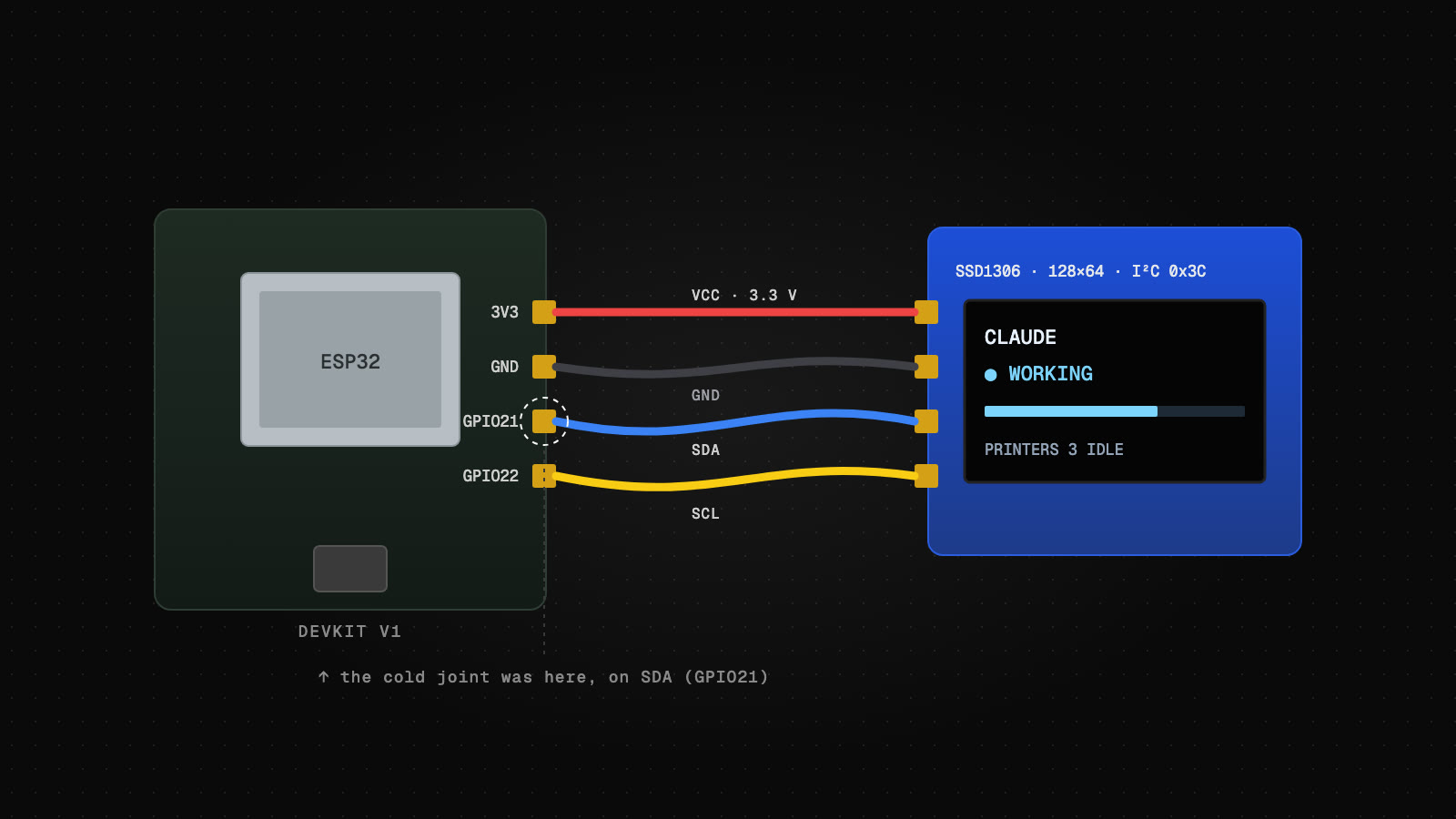
An ESP32 with a 128 × 64 OLED, a rotary encoder and two buttons, soldered to a small carrier board. It shows what my AI coding agents are doing, pulls live numbers from the shop’s Odoo, and lists which printers are idle so I can mark them ready from the knob.
The first bug
At first the screen stayed black. Instead of guessing, I wrote a wiring check that runs at boot and prints which pins are connected. It showed GPIO 21, the I²C data line, wasn’t connected to anything. It was a cold solder joint. I reflowed it and the display came up straight away.
Soldring
A web app for the soldering bench. You open a build or upload a schematic, point a webcam at the board and tap its four corners. Every pad you still have to solder lights up on the screen.
Its first build is an ESP32 with a small OLED that shows my AI usage: four wires, 3.3 V power, and I²C on pins 21 and 22.
When nothing works, stop guessing and make the board tell you what’s connected.